
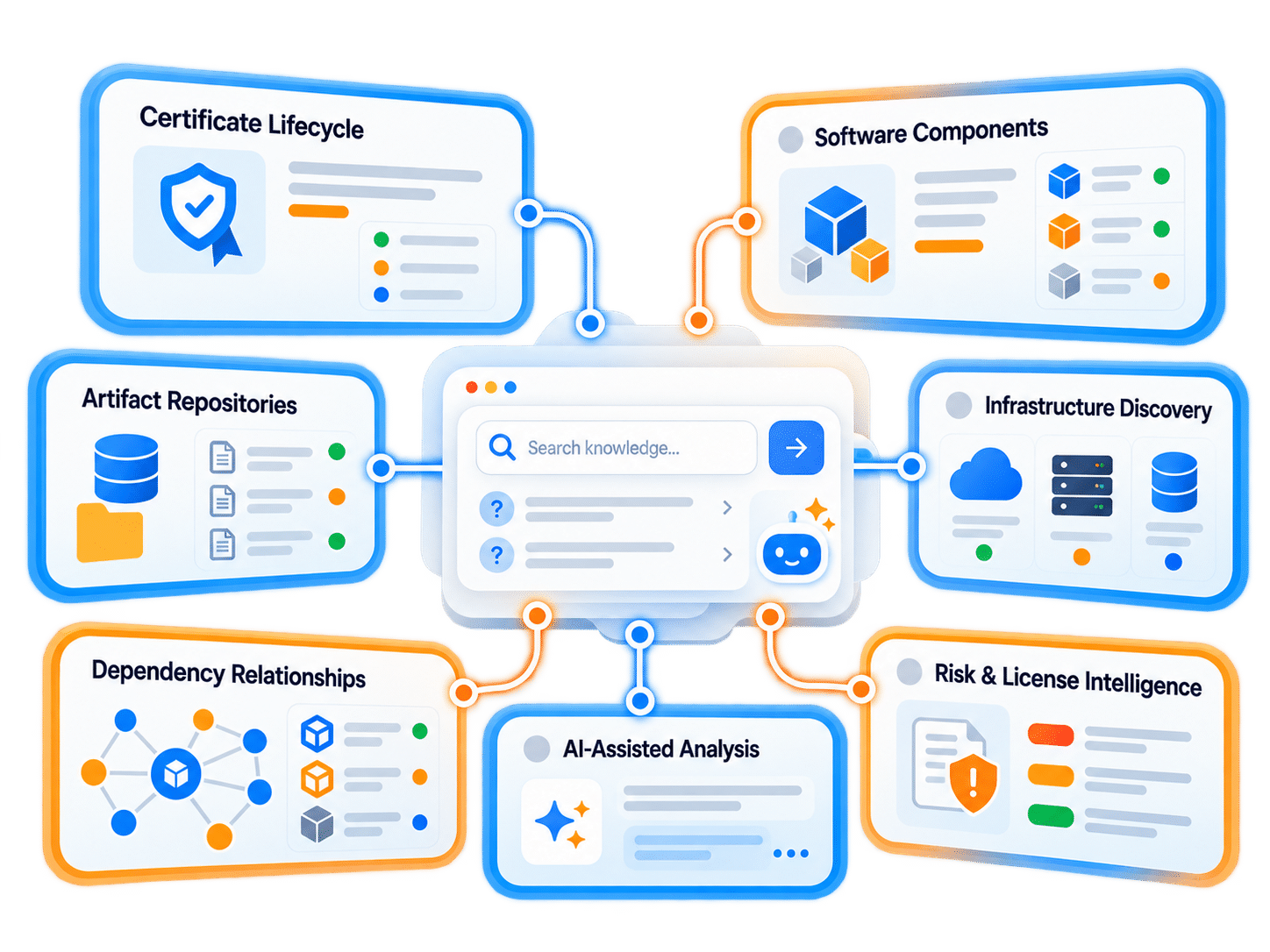
AssetUno is an enterprise Digital Asset Intelligence and Automation platform designed to help organizations discover what exists, understand where it is used, evaluate the surrounding risk and license context, and automate selected technology operations.
ASSETUNO FAQ
Questions, answered.
Find answers about AssetUno, infrastructure discovery, Auto Suite, certificate lifecycle automation, Software Component Intelligence, repository intelligence, risk and license intelligence, Font Intelligence, AI-assisted analysis, enterprise integrations and deployment.
About AssetUno
What is AssetUno?
AssetUno is an enterprise Digital Asset Intelligence and Automation platform that brings infrastructure discovery, certificate intelligence and lifecycle automation, software component intelligence, repository intelligence, risk and license context, and AI-assisted analysis into one connected platform.
What problem does AssetUno solve?
Enterprise technology data is often fragmented across infrastructure, certificates, repositories, software components and operational tools. AssetUno helps organizations discover these assets, understand their relationships and risk context, and automate selected operational workflows from a single platform.
What does AssetUno help organizations understand?
AssetUno is designed to help answer practical questions such as what exists in the environment, where it is located, what it is connected to, where a component is used, whether a certificate is approaching expiry, what license or entitlement context applies, what risk signals exist, and what can be automated.
Is AssetUno a traditional IT asset management, SAM or CMDB tool?
No. AssetUno complements existing ITAM, SAM and CMDB platforms by adding deeper discovery, component, certificate, repository, relationship and automation intelligence. It can provide evidence and context that broader asset-management systems do not always capture in detail.
Is AssetUno a media Digital Asset Management system?
No. AssetUno is not designed to manage marketing files, images or creative media. Digital Asset Intelligence in AssetUno refers to enterprise technology assets and relationships such as certificates, software components, dependencies, repositories, fonts and infrastructure evidence.
Who is AssetUno designed for?
AssetUno is designed for enterprise IT operations, infrastructure, PKI, cybersecurity, software asset management, IT asset management, enterprise architecture, procurement, risk, audit and compliance teams that need better technology visibility and operational control.
Discovery & Infrastructure
What can AssetUno discover across the infrastructure?
AssetUno can discover and classify technology targets across network segments, IP ranges, known systems, external endpoints and supported infrastructure environments, then correlate the resulting evidence with certificates, components and other platform intelligence.
Does AssetUno support Windows and Linux environments?
Yes. AssetUno supports discovery and classification across Windows and Linux or Unix environments, including service and technology context where supported by the selected discovery method.
Can AssetUno work across cloud and hybrid environments?
Yes. AssetUno is designed for mixed enterprise environments and can bring infrastructure context from on-premises and supported cloud targets into a unified discovery model.
Does AssetUno support Kubernetes environments?
AssetUno includes Kubernetes-oriented discovery capabilities for supported environments, including cluster-related infrastructure context.
Can AssetUno discover external web and TLS endpoints?
Yes. External web and TLS endpoints can be included in discovery so organizations can bring externally reachable services and certificate evidence into the same visibility model.
Does AssetUno support credential-assisted discovery?
Yes. Where deeper classification requires authenticated access, AssetUno can use approved credential providers and controlled credentials to enrich discovery while preserving access traceability and secret protection.
Certificate Intelligence & Auto Suite
What is Certificate Intelligence in AssetUno?
Certificate Intelligence provides visibility into discovered certificates, their usage context, lifecycle status, expiry information and relationships to systems and services so teams can identify certificate-related operational risk before it becomes an outage.
What is AssetUno Auto Suite?
Auto Suite is AssetUno’s certificate lifecycle automation capability. It is designed to automate operational steps from certificate request and validation through issuance, deployment, verification, renewal and audit.
What does the certificate automation workflow look like?
A typical Auto Suite workflow follows Request, Validate, Issue, Deploy, Verify, Renew and Audit. The exact workflow can be adapted to the certificate authority, target environment and operational process.
Can AssetUno integrate with certificate authorities?
Yes. Auto Suite is designed to integrate with supported certificate authority providers and automate the operational lifecycle around certificate issuance and renewal.
What deployment targets can Auto Suite support?
Auto Suite is designed for enterprise certificate deployment scenarios including Windows and IIS, Linux and web servers, Java and JKS environments, and PKCS12 or other supported certificate targets.
How does AssetUno help prevent certificate-related outages?
AssetUno combines certificate discovery, expiry visibility, lifecycle status, automation tasks, deployment verification and renewal workflows so teams can identify and address expiring or unmanaged certificates earlier.
Does AssetUno verify a certificate after deployment?
Auto Suite includes verification as part of the lifecycle workflow so teams can confirm that a deployment step completed successfully before treating the lifecycle task as complete.
Does AssetUno keep certificate lifecycle history?
Yes. Lifecycle status, automation tasks, verification and audit evidence are designed to remain traceable so teams can review what happened and when.
Does Auto Suite replace a certificate authority or PKI?
No. AssetUno works with certificate authorities and enterprise PKI processes. Auto Suite automates and governs lifecycle operations around certificates rather than acting as the certificate authority itself.
Does AssetUno replace every dedicated certificate lifecycle management product?
That depends on the organization’s requirements. Auto Suite covers core lifecycle automation and governance workflows, but organizations with specialized PKI or CLM requirements should evaluate the required integrations, policies and operating model during an assessment.
Software Component Intelligence
What is Software Component Intelligence?
Software Component Intelligence helps organizations identify software components, binaries, packages, dependencies, versions and related evidence, then connect that information to applications, systems, repositories and risk context.
What does the AssetUno component model look like?
AssetUno is designed to connect Host, Application, Component, Repository and Risk Context so teams can move from a discovered component to the systems and applications that depend on it.
What is where-used intelligence?
Where-used intelligence shows where a discovered component, binary, package or dependency is used across the environment. This helps teams understand impact before changing, upgrading, removing or remediating a component.
Can AssetUno analyze DLL and binary evidence?
Yes. Binary and DLL evidence can be used as part of component discovery and classification so organizations can identify component versions, publisher context and relationships that may otherwise remain hidden.
Does AssetUno provide dependency intelligence?
Yes. Dependency intelligence is a core part of the component model and helps organizations understand relationships between software components, applications, repositories and the systems that use them.
Does AssetUno replace a software composition analysis tool?
AssetUno focuses on enterprise component discovery, where-used relationships, repository intelligence, license and risk context. It can complement SCA tooling, especially where organizations need to connect repository data with deployed infrastructure and operational evidence.
Artifact Repository Intelligence
What is Artifact Repository Intelligence?
Artifact Repository Intelligence discovers repository and package information, connects it with component evidence, and helps teams understand where software artifacts originate, how they relate to deployed components and what governance context applies.
Which repository platforms can AssetUno work with?
AssetUno’s repository intelligence is designed for enterprise platforms such as JFrog Artifactory, Nexus Repository, GitHub Packages or GHCR, GitLab Registry, Harbor and Azure Artifacts, subject to the configured connector and permissions.
What information can AssetUno discover from repositories?
Depending on the provider, AssetUno can discover repository and package context, provider coverage, component relationships and synchronization status, then persist evidence for review and reconciliation.
How does repository information connect to Component Intelligence?
Repository evidence is reconciled with discovered software components so teams can understand the relationship between repository packages, deployed components, versions, dependencies and where-used context.
Does AssetUno support background synchronization?
Yes. Repository intelligence includes background synchronization, progress and status visibility, controlled cancellation and persisted evidence or history for supported providers.
Risk, Vulnerability & License Intelligence
What is Risk & License Intelligence?
Risk & License Intelligence adds governance context to discovered technology evidence. It brings together risk scoring, repository trust, ownership gaps, license context, entitlement information and vulnerability enrichment to help teams prioritize review and remediation.
Does AssetUno provide vulnerability context?
AssetUno is designed to enrich component intelligence with vulnerability and CVE context where supported, allowing teams to connect technical risk signals to actual components and where-used relationships.
Can AssetUno identify open-source and commercial license context?
Yes. AssetUno can classify license context such as MIT, Apache-2.0, GPL, LGPL, commercial and unknown where the available evidence supports that classification.
Can AssetUno identify license conflicts or unknown licensing?
AssetUno can surface license conflict signals, commercial or unknown license context and items requiring review so teams can focus investigation on evidence that may create legal, procurement or governance exposure.
Does AssetUno support contract and entitlement mapping?
AssetUno includes contract and entitlement mapping capabilities so discovered components and software evidence can be evaluated against available commercial or entitlement context.
How does AssetUno prioritize risk?
Risk prioritization combines the evidence available for a component or asset, such as vulnerability context, repository trust, ownership gaps, license status and relationship data, rather than treating every discovered item as equally important.
Font Intelligence
What is Font Intelligence?
Font Intelligence discovers installed or file-based font evidence and brings font family, version, publisher, usage and license context into the same enterprise visibility model.
Why are fonts included in AssetUno?
Commercial and unmanaged fonts can create licensing and governance exposure but are often missed by traditional software inventory processes. AssetUno treats fonts as a first-class asset type rather than an incidental file.
Can AssetUno identify where a font is used?
AssetUno can correlate discovered font evidence with device, application and usage context where that evidence is available, helping teams understand the scope of a licensing review.
Does AssetUno evaluate font license context?
Yes. Font Intelligence can help distinguish commercial, unknown and other license context and connect the evidence to the shared License Intelligence and governance workflow.
Can font evidence be connected to contracts or entitlements?
Yes. Font licensing can be evaluated through the same contract, entitlement and review model used by AssetUno’s broader License Intelligence capabilities.
AI & Ask AssetUno
What is Ask AssetUno?
Ask AssetUno is the AI-assisted analysis experience for querying AssetUno’s discovered technology data and relationships using natural language.
What can users ask AssetUno?
Examples include asking which certificates expire soon, where a component is used, which applications depend on a DLL version, which components have risk or licensing concerns, and which systems require attention.
Does Ask AssetUno use the data already discovered by the platform?
Yes. The purpose of Ask AssetUno is to reason over AssetUno’s own discovered evidence, relationships and governance context rather than act as a generic chatbot disconnected from the platform.
Can organizations use their own AI provider?
AssetUno is designed to support supported AI providers as well as custom or compatible AI endpoints, allowing organizations to align AI-assisted analysis with their architecture and governance requirements.
Is AI required to use AssetUno?
No. Core discovery, inventory, relationship, automation and governance capabilities do not depend on conversational AI. AI-assisted analysis is an additional way to work with the platform’s data.
Enterprise Integrations & Security
Which identity providers can AssetUno integrate with?
AssetUno is designed to support local users as well as enterprise identity integrations such as LDAP, Microsoft Active Directory, Microsoft Entra ID, Okta or Keycloak, and supported OIDC or SAML configurations.
Can AssetUno integrate with enterprise credential or PAM platforms?
Yes. Supported credential-provider patterns include local credential storage and enterprise secret or PAM platforms such as CyberArk, Delinea Secret Server, BeyondTrust Password Safe, HashiCorp Vault and generic REST-based secret providers.
Does AssetUno expose a public API?
AssetUno includes a public API model for controlled external integration, service accounts, API tokens and automation or data exchange scenarios.
How are secrets handled?
AssetUno is designed to protect secrets through controlled credential handling and redaction. Raw secrets should not be displayed to users or written into audit records.
Does AssetUno provide audit logging?
Yes. Audit and access traceability are part of the platform design, including activity history and provider test or integration evidence where applicable.
Can access be restricted by role?
AssetUno includes role-based access concepts so administrative, governance, connector and other platform capabilities can be separated according to user responsibilities.
Deployment & Languages
Can AssetUno be used in enterprise-controlled environments?
Yes. AssetUno is designed for enterprise deployments where organizations require controlled infrastructure, credentials, identity integration and governance boundaries.
Does AssetUno support on-premises and hybrid scenarios?
Yes. AssetUno is designed for on-premises and hybrid enterprise environments. The exact architecture should be selected according to discovery scope, integrations, security requirements and operational ownership.
Can AssetUno work with mixed infrastructure?
Yes. The platform is designed to correlate evidence across on-premises infrastructure, supported cloud targets, repositories, web or TLS endpoints and other connected enterprise environments.
Which languages does the AssetUno interface support?
The AssetUno interface supports English, Türkçe, Deutsch and Italiano.
How should deployment requirements be evaluated?
Deployment should be scoped against the target infrastructure, required connectors, identity and credential providers, repository access, automation targets and security controls. These are typically confirmed during the demo or Discovery & Automation Assessment.
Pricing & Licensing
How is AssetUno priced?
AssetUno pricing is based on the agreed product scope, modules, environment and enterprise scale. Exact commercial terms are provided after the required coverage and deployment model are understood.
Are all AssetUno capabilities included in every commercial scope?
Not necessarily. AssetUno is modular, so the commercial scope can be aligned with the capabilities required by the organization, such as Auto Suite, Component Intelligence, discovery, repository intelligence or broader governance capabilities.
Why are pricing tiers not published on this page?
AssetUno now covers multiple discovery, intelligence and automation domains. A single public capacity number can be misleading, so pricing is confirmed against the actual module and environment scope.
How can we get a commercial proposal?
Request a demo or Discovery & Automation Assessment and provide the areas you want to evaluate. AssetUno can then confirm the relevant scope and commercial model.
Discovery & Automation Assessment
What is the Discovery & Automation Assessment?
The Discovery & Automation Assessment is a focused engagement used to understand the target environment, connect the required sources, discover relevant evidence, identify automation opportunities and review the resulting findings.
What are the main assessment stages?
The assessment follows five practical stages: Scope, Connect, Discover, Automate and Review.
What can be included in the assessment?
The scope can include infrastructure discovery, certificate visibility and lifecycle automation, component and repository intelligence, risk and license context, fonts, integrations and other relevant AssetUno capabilities.
Who should request an assessment?
Organizations that want to validate AssetUno against their own environment, understand current visibility gaps, test an automation use case or define a broader rollout plan are suitable candidates.
How do we start?
Use the Request a Demo form and select the capabilities you want to explore. If the scope is not yet clear, choose Not sure yet and the AssetUno team can help define a focused assessment.
Still have a question?
See AssetUno against your own environment and use cases. We can tailor a demo around the capabilities that matter to your organization.